Sticky mats look like protection. They aren’t.

Dycem outperforms sticky mats in every metric, from capture rates to cost savings.
Request a Site Assessment

One design choice drives every difference.

A tacky mat relies on a manufactured adhesive that loads up and loses tack step by step. Dycem uses a patented polymeric surface with a natural tack that cleaning restores rather than use consumes — and, unlike a tacky mat, its performance is measured, not assumed.

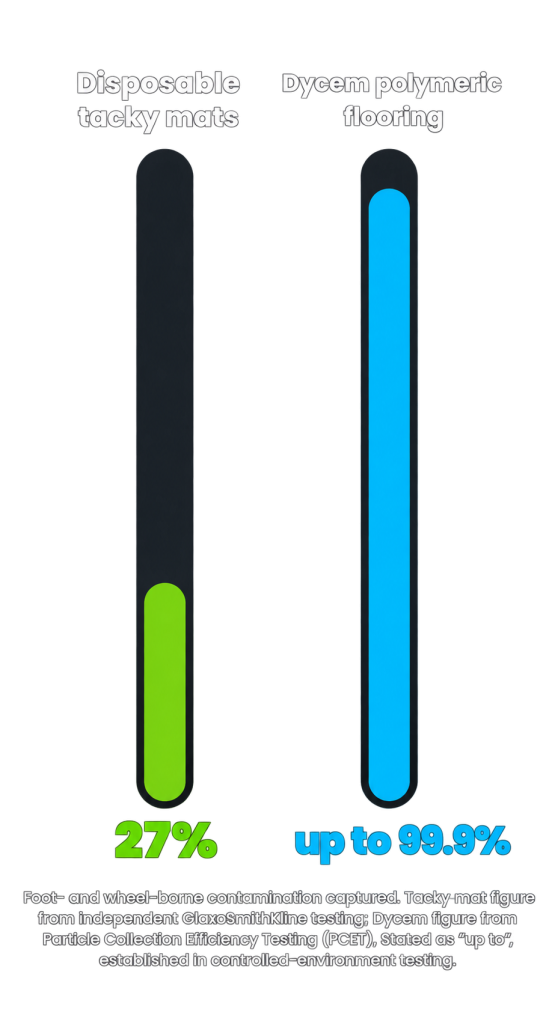
27%

Tacky-mat effectiveness against foot- and wheel-borne contamination
Independent GlaxoSmithKline testing

99%

Foot- and wheel-borne capture with Dycem polymeric flooring (up to)
Dycem testing

3-5 years

Washable service life, with annual capture verification
Reusable — no per-use waste

Dycem vs Sticky Mats

Dycem doesn’t just compete with sticky mats, we outperform them by delivering up to 99% contamination control in an effective, long-lasting, and sustainable way.

Request a Sample
Features Dycem Lite Sticky Mats
Capture mechanism Natural-tack polymer, restored by cleaning Manufactured adhesive, consumed by use
Foot & wheel capture Up to 99.9% (Dycem PCET) ~27% (GSK testing)
Verification Annual PCET verification on your floor None — effectiveness is assumed, not measured
Effective coverage Cut to the traffic path; supports required footfalls and rotations Common field sizes cleared in 1–2 strides; often stepped over
Reliance on behavior Passive — works without depending on compliance Only works if peeled on schedule and fully crossed
Redistribution risk Retains what it captures until cleaned High once loaded; can re-deposit particles
Wheeled traffic Bonded, trafficable surface incl. heavy-wheeled Wraps, lifts, and tears under carts and lifts
Walking-surface safety Bonded flush — no lip, no peel step Raised backerboard edge + curling sheets = trip hazard
ESD Protected 10⁸ ohms No
Supply model One install; a single global standard Perpetual consumable; per-region reorder & stock
Waste profile Reusable — no per-use waste stream Recurring single-use contaminated plastic to landfill
Cost profile Higher upfront, lower total cost of ownership Low upfront, higher over service life
Dycem Lite
  • Capture mechanism Natural-tack polymer, restored by cleaning
  • Foot & wheel capture Up to 99.9% (Dycem PCET)
  • Verification Annual PCET verification on your floor
  • Effective coverage Cut to the traffic path; supports required footfalls and rotations
  • Reliance on behavior Passive — works without depending on compliance
  • Redistribution risk Retains what it captures until cleaned
  • Wheeled traffic Bonded, trafficable surface incl. heavy-wheeled
  • Walking-surface safety Bonded flush — no lip, no peel step
  • ESD Protected 10⁸ ohms
  • Supply model One install; a single global standard
  • Waste profile Reusable — no per-use waste stream
  • Cost profile Higher upfront, lower total cost of ownership
Sticky Mats
  • Capture mechanism Manufactured adhesive, consumed by use
  • Foot & wheel capture ~27% (GSK testing)
  • Verification None — effectiveness is assumed, not measured
  • Effective coverage Common field sizes cleared in 1–2 strides; often stepped over
  • Reliance on behavior Only works if peeled on schedule and fully crossed
  • Redistribution risk High once loaded; can re-deposit particles
  • Wheeled traffic Wraps, lifts, and tears under carts and lifts
  • Walking-surface safety Raised backerboard edge + curling sheets = trip hazard
  • ESD No
  • Supply model Perpetual consumable; per-region reorder & stock
  • Waste profile Recurring single-use contaminated plastic to landfill
  • Cost profile Low upfront, higher over service life

See What Our Customers say

These is no question in the superiority of the particle capture efficiency of Dycem over the sticky mat. It has been a pleasure working with Dycem in keeping our cleanroom floors clean.

Dan Bartelston Lockheed Martin

We have found the Dycem mates to be effective and simple to maintain, they look smart and are far superior to traditional sticky mats.

George Brown Rolls-Royce

We had suffered the classic sticky mats for many years before we were fortunate enough to find Dycem. After a trial, we installed across the whole site. Great results and everybody happy.

Nigel Disney Ontic

After doing some product research, we decided to try a Dycem mat vs a sticky mat from 2 scenarios. We were looking at functionality and cost. After our trial run, the functionality was better than the sticky mat approach for effectiveness and the costs were yielding savings. The net was a win-win scenario so we have changed our standard operations at this facility. We are pleased with the performance of this product.

Dave Morrison Rogers Builders

They work better. They look better. They save money. A true game changer for controlling and preventing contamination from entering critical production areas.

Brian Marchetti COMPUSITE

Very easy to clean, they trap dust & dirt very well, and they look great. I am also very pleased with the fact that they last three to five years, which should be. a significant cost savings...

Assistant Chief Engineer CBRE

We utilize Dycem's reusable floor mats to demonstrate the commitment of SDSC to environmental sustainability. Over time, the durable nature of these mats means reduced replacement costs and waste, aligning fiscal responsibility with eco-conscious choices.

Thomas Tate, SDSC Data Center Manager University of California, San Diego

"Contamination control measures are essential to maintaining Data Centre uptime, helping prevent premature component failure and other related issues within your IT and supporting infrastructure equipment.

By combining strict control policies with physical products such as Dycem mats, alongside regular deep cleans, you will ensure most floor-based contaminants are captured before they can cause an issue, thereby contributing to achieving ISO14644 Class 8 or greater standards within your critical environments."

Mark Chappel Data Center Operations Manager

Dycem mats have significantly improved contamination control in our electronics assembly area. They're reliable, low-maintenance and essential for protecting our high precision components.

Hitachi Astemo

Why Switch?

Sticky mats may seem convenient, but they’re not doing the job effectively. Studies show they are only up to 27% effective, create a trip hazard, and need frequent replacement, leading to inconsistent performance and higher long-term costs.

Dycem contamination control mats provide a proven, long-term solution that attracts, captures, and retains up to 99.9% of contaminants from shoes and wheels, and up to 75% of airborne particles, reducing contamination at the source. Organizations switch to Dycem from sticky mats because they need reliable, consistent floor-level contamination control that meets the highest standards without the waste, mess, or maintenance.

Learn More

Captures up to 99.9% of floor-level contamination

Unlike disposable sticky mats, Dycem is scientifically proven to capture up to 99.9% of contamination from both feet and wheels. Its naturally tacky, smooth surface attracts, captures, and retains particles, helping to keep them out of your controlled environment.

3-5 year average lifespan

Dycem’s washable surface allows for easy maintenance; regular cleaning restores its tacky polymer layer to maintain optimal performance. With correct upkeep, Dycem typically lasts 3 to 5 years.

ESD

All Dycem products incorporate Biomaster, an antimicrobial additive that uses silver ion technology to proactively inhibit and disrupt the growth of microorganisms, including Salmonella, Listeria, and E. coli.

Get specified at design

Selling mats site by site is a grind. Getting Dycem written into the basis-of-design and facility standard — through consulting engineers, commissioning agents, and the operator’s own design-standards team — means it’s specified for every new build, and tacky mats become the non-compliant exception rather than the default.

That also compounds across an estate: one global standard instead of a per-region consumable turns a single-site foothold into an estate-wide default without re-selling each location — and removes a supply-chain dependency at the same time. One last soft edge: a curling, half-peeled mat at the threshold of a flagship AI facility is a poor first impression on the customer and tenant tours these operators run constantly.

01

Design-phase inclusion.

Specified once, applied to every build.

02

Exception flips.

Tacky mats become the deviation to justify.

03

Estate standardization.

One global standard across NA / EMEA / APAC.

04

First impression.

A clean, engineered threshold on every tour.

Make the case to the right owner

Floor-level contamination touches four different owners, and each one has a different reason to care.

Dycem is scientifically proven to capture up to:

99%

or floor-level
continamtion

75%

of airborne particles


Pick the seat at the table

Data center operations

Contamination is a chronic cost, not an event. 27% capture is a gap you carry every shift. For colo and wholesale, contamination can reach the SLA.

EHS, Risk & Legal

Sticky mats are a trip and fall hazard. Dycem removes the hazard entirely.

Procurement & Finance

The real cost, and a spec you can't standardize. Dycem is a verifiable spec is easier to standardize. Capex vs. opex, your call.

Sustainability

Tacky mats are a recurring single-use plastic stream. It runs straight against published targets. Dycem is a reusable on a schedule.

The objections you’ll hear and the reframe

Every Dycem system captures contamination at floor level. Choose the surface that fits your environment.

Talk to an expert

“We’ve always used them.”

Familiarity isn’t performance. The status quo is a control that captures around a quarter of what crosses it, can’t be measured, and adds a trip hazard — that’s the risk, not the safe choice. Density is rising; the cost of “always” is rising with it.

“They’re good enough.”

Independent testing puts effectiveness near 27%, and nothing about a tacky mat is verifiable on your floor. Dycem is the only option here that can show you what it’s actually capturing.

“They’re cheaper.”

Cheaper on day one only. Across the service life, replacement sheets, peel labor, disposal, storage, and reorder admin overtake the upfront saving — and a managed-service option lets you match the recurring-cost shape without a discount. 

“They’re simpler.”

Simple to purchase, not simple to rely on. A tacky mat only works if someone peels it on schedule and everyone crosses it fully — a daily compliance dependency. Dycem is washed on a schedule and works passively the rest of the time.

The Bottom Line

Tacky mats look like contamination control and cost like a bargain. In a live data hall — constant wheeled traffic, rising density, aggressive uptime targets, ESG commitments on record — they under-deliver on capture at the sizes actually in use, can’t be measured, add an avoidable trip-and-fall liability, create a recurring waste stream, and depend on a peel step that rarely happens. Dycem delivers verifiable floor-level capture, removes the edge hazard, standardizes cleanly across sites, and takes the single-use plastic out of the equation.

See what’s actually crossing your thresholds

Next step...

A Dycem baseline site assessment samples the particulate at your white-space entries, maps your traffic paths, sizes coverage to your real footfall and wheel loads, and models total cost against your current mats — turning an invisible problem into a number your team can act on.