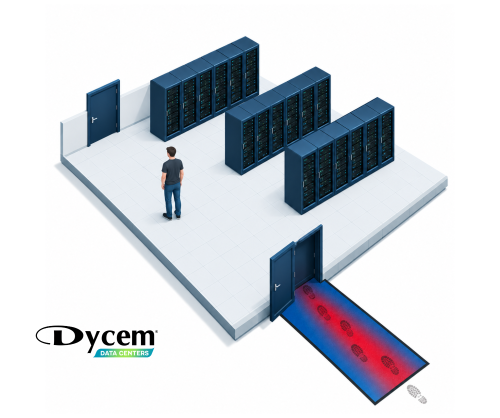
Why Floor-Level Contamination Control is Important in Data Centers

Contamination in Data Centers

A Hidden Risk to Uptime Reliability, Cooling Efficiency, and Safety.

In mission-critical environments, even microscopic contamination can compromise uptime, damage sensitive equipment, or shorten hardware lifespan. Contamination in a data center is not limited to visible dust.  It is any unwanted particulate, residue, or microbe capable of degrading performance or increasing risk.

Effective contamination control starts by understanding how particles enter the facility, how they move through the data hall, and where they can be captured before reaching critical equipment.

How Contamination Enters Your Data Center

Most contamination is carried into the facility rather than generated inside the white space. People bring it on clothing and footwear; carts and equipment roll it in; outside air delivers it through intakes; and construction or maintenance releases it directly into controlled zones. Once inside, traffic moves contamination across the floor. Airflow can then redistribute settled particles through the room, while raised-floor systems may carry debris from the underfloor plenum through perforated tiles and toward equipment.

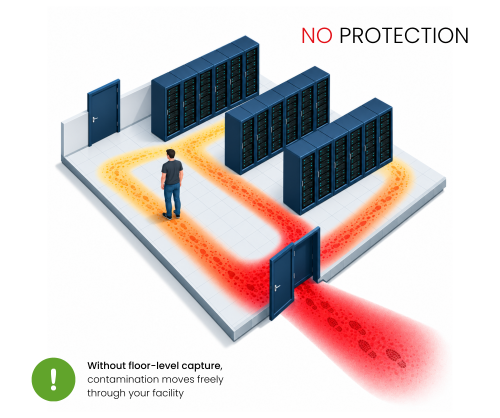
The most important point for control: a large share of particulate enters at floor level, on shoes and wheels, and settles on the floor before it is redistributed. Capturing it at entrances and transitions helps prevent it from moving further into the data hall.
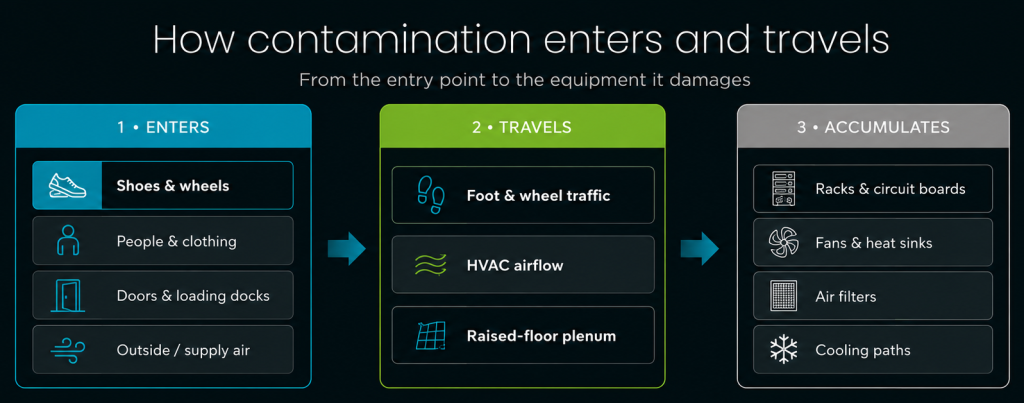
Figure 1. How contamination enters a facility, moves through it, and accumulates in equipment — and the floor-level route Dycem intercepts.
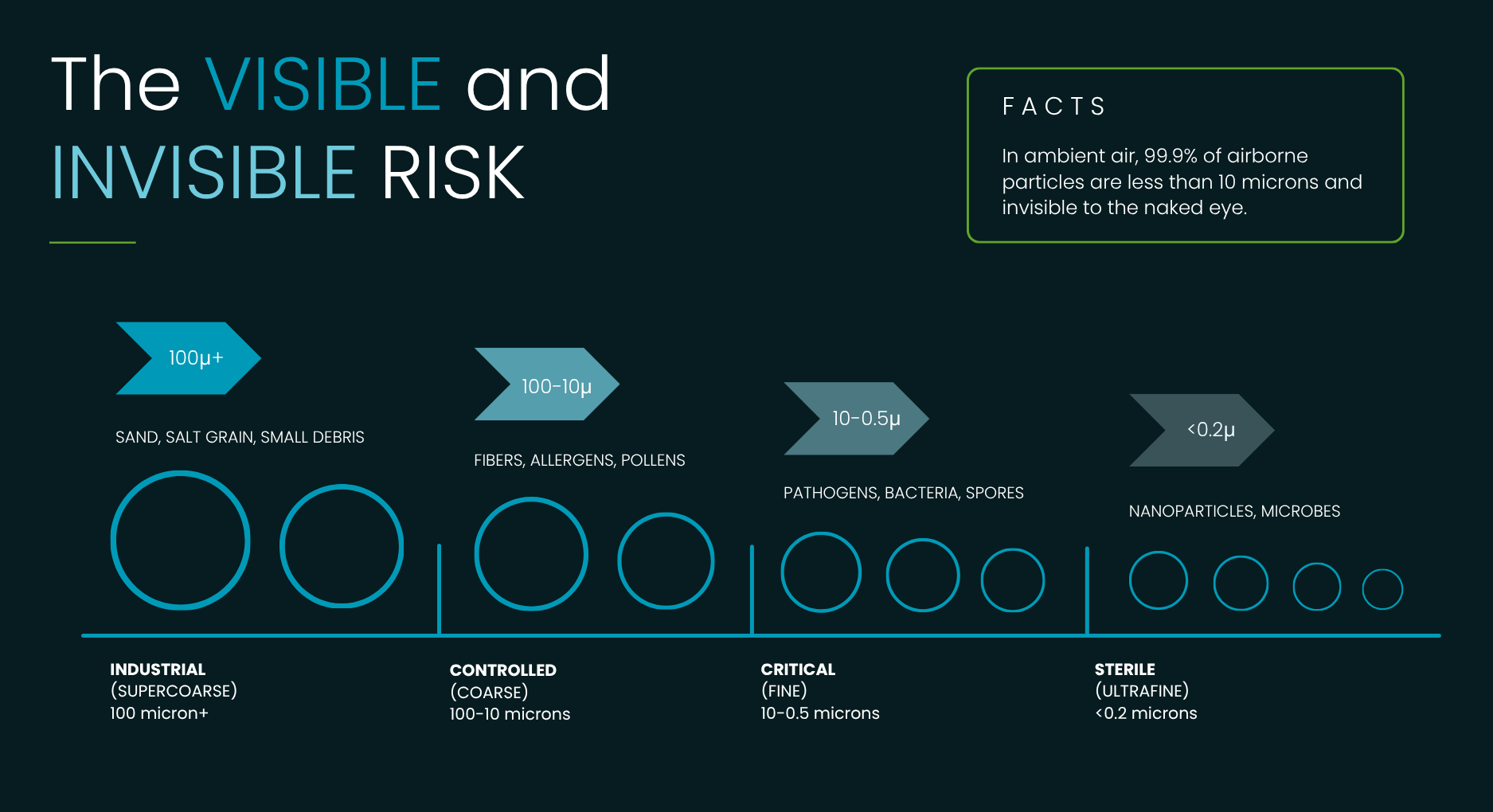
Types of Data Center Contamination

Contamination in data centers falls into three broad categories, although not all pose the same level of risk.

Physical (particulate)

Particulate contamination is the most prevalent contamination risk in data centers. It includes dust, fibers, metallic particles, zinc whiskers, and other fine debris. These contaminants can restrict airflow, clog filters and heat sinks, and cause electrical shorts or premature equipment failure.

Chemical (gaseous)

Corrosive gases react with the metals on circuit boards and cause creep corrosion, a progressive failure that can kill hardware even in a visibly clean room. It has its own severity scale and is a serious, often-overlooked risk for facilities near industrial or high-pollution areas.

Microbiological

Corrosive gases react with the metals on circuit boards and cause creep corrosion, a progressive failure that can kill hardware even in a visibly clean room. It has its own severity scale and is a serious, often-overlooked risk for facilities near industrial or high-pollution areas.

What Contamination Can Affect

Contamination works against the core priorities of data center operations: availability, thermal performance, and equipment reliability.

Contamination can cause:

• Reduced reliability and life of the equipment as dust builds up on and inside equipment
• Service interruptions and downtime, often from intermittent, hard-to-diagnose faults
• Airflow restriction and cooling inefficiency as filters, fans, and heat sinks clog, forcing thermal throttling
• Increased scrutiny during audits and technical reviews
• Direct hardware damage, from conductive shorts to gaseous creep corrosion
• Elevated fire risk where particulate accumulates in dense, high-power environments

Where Contamination Comes From

Three recurring sources account for most of the contamination load:

Personnel

Technicians, contractors, and visitors continuously shed skin and hair particles and track in outside dust on clothing and footwear. Footwear is one of the most consistent routes through which contamination crosses into controlled areas.

Facility

Raised floors trap dust beneath the tiles, and construction or fit-out activity releases particulate and debris into controlled spaces.

Atmosphere

Airborne contaminants such as pollen, spores, and fine pollution particles enter through ventilation and during maintenance.

Across all three, the common thread is movement at floor level. Most of what enters does so at the floor level, on shoes, wheels, and settling dust, which is exactly why the floor is the most effective place to intercept it.

Data Center Cleanliness Standards and Targets

Data center contamination is governed by several recognized standards, and technical guidelines are used to assess and manage data center environmental conditions.

Cleaning

ISO 14644-1

Defines airborne cleanliness levels and particle concentration limits for classified clean environments. Many data centers reference ISO Class 8 to support reliable operation of sensitive equipment and high-density computing equipment.

ISO 14644-2

Provides guidance for monitoring and maintaining cleanliness during daily operations.

ASHRAE TC 9.9

Provides data center–specific guidance on environmental risks, including recommended approaches to temperature, humidity, particulate contamination and gaseous corrosion.

ISA-71.04

Classifies gaseous corrosion severity; G1, or mild, is commonly used as the target condition for data center environments.

Why Contamination Control Matters for AI Infrastructure

As demand for data centers accelerates with the expansion of AI, environmental requirements are tightening. High-performance hardware such as NVIDIA GPUs now calls for ISO Class 8 conditions to ensure reliability and peak performance.

Denser racks also move more air and generate more heat, which pulls a greater volume of particulate through the facility and concentrates it precisely where it does the most damage. The result is a growing need for contamination control at every level. Maintaining controlled conditions around sensitive equipment requires contamination prevention throughout the facility, including at the floor level.

Read the AI Ready Date Center Guide

Contamination Control Across the Facility Lifecycle

The risks change as a facility moves from build to operation, but so does the right floor level contamination control.
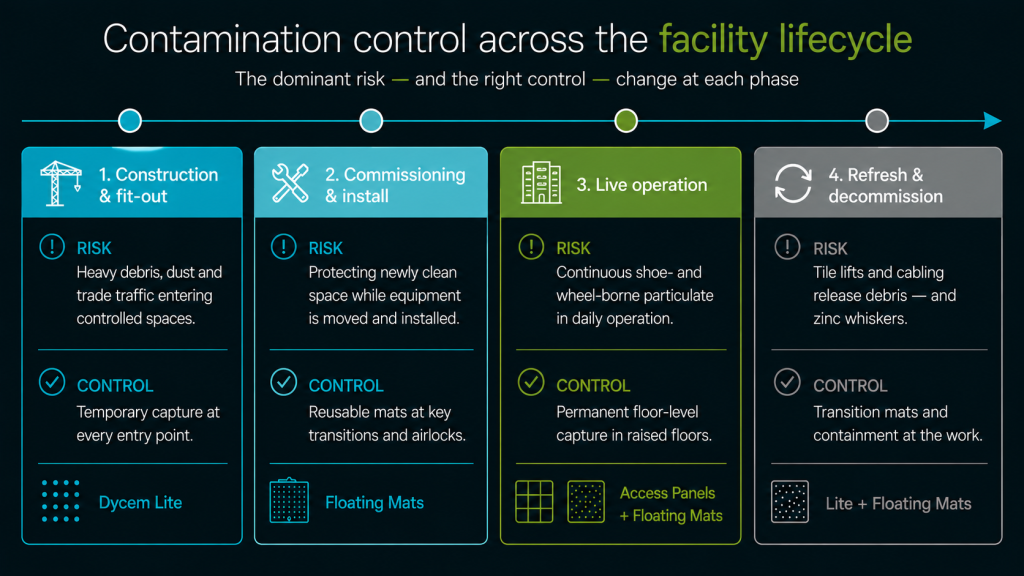
Figure 2. The dominant contamination risk and the recommended control at each phase of the facility lifecycle.
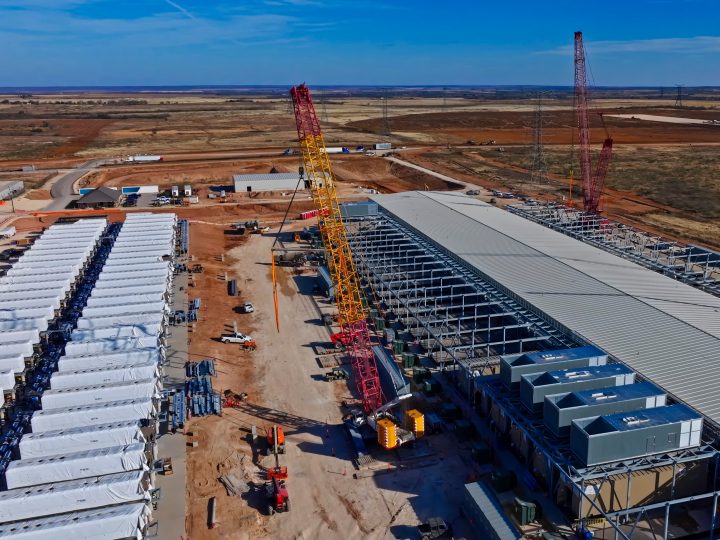
Construction

Temporary floor-level controls help prevent dust and building debris from being carried into completed or controlled areas.
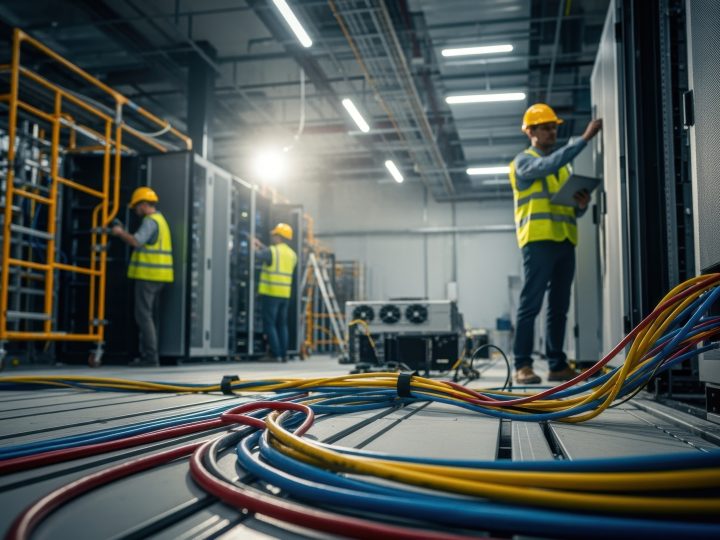
Commissioning and Equipment Installation

Reusable contamination-control solutions protect newly cleaned spaces as technicians, racks, tools and equipment move through the facility.
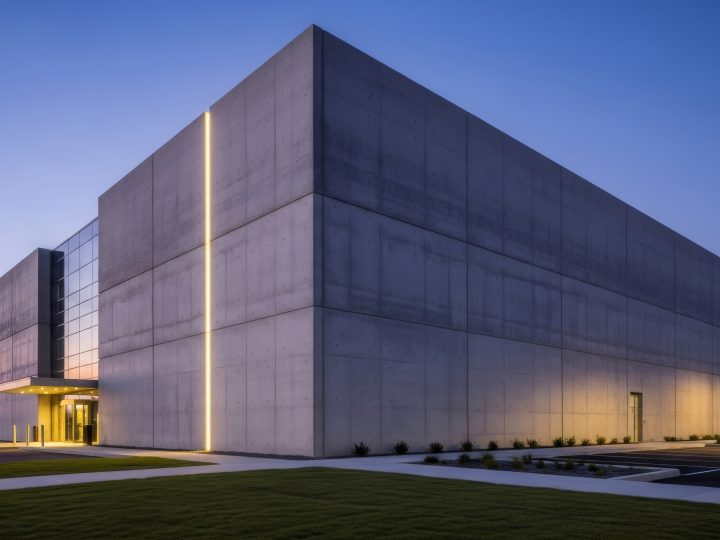
Live Operation

Permanent or long-term floor-level capture helps control the continuous contamination load created by daily personnel and wheeled traffic.
Refresh, Expansion and Decommissioning

It’s during these phases where there is the greatest chance of contamination control becoming critical again, because these are events that release settled debris and zinc whiskers.

A Layered Approach to Contamination Control

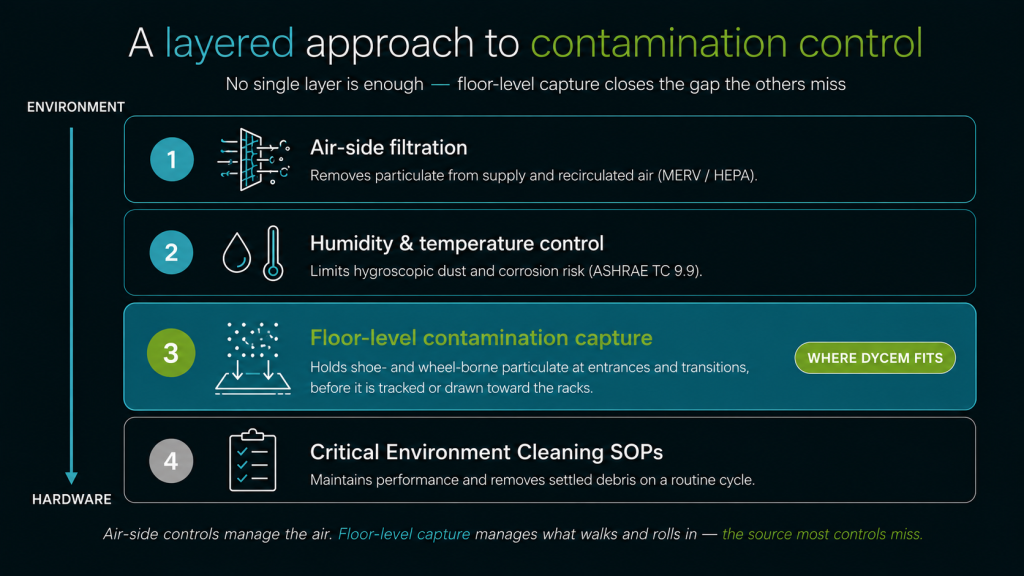
Effective contamination control in a data center takes a layered approach.
Air filtration, humidity and temperature control, and gaseous scrubbing each manage part of the problem, but they all manage the air.
Floor-level contamination control addresses a different part of the problem: the particulate carried into the facility on footwear and wheels.

Placed at entrances, transition points and other high-traffic control zones, Dycem captures and retains contamination before it can be tracked further into the data hall or redistributed by airflow.
Combined with routine critical environment cleaning SOPs, it completes a defense that protects equipment from every direction.
Assess Your Data Center’s Contamination Risk

A quick way to gauge your exposure is to inspect the area with the following items. The more that apply, the stronger the case for floor-level control.

Request a Site Survey where our team will identify your highest-risk areas and recommend placement and types of contamination control flooring.

Get In Touch

Raised-floor construction, especially with older or zinc-plated tiles

High personnel and equipment traffic, or frequent maintenance

Active construction or fit-out in or near live halls

High-density or GPU deployments targeting ISO Class 8

Reliance on disposable sticky mats, or no floor-level control at all

See What Our Customers say

These is no question in the superiority of the particle capture efficiency of Dycem over the sticky mat. It has been a pleasure working with Dycem in keeping our cleanroom floors clean.

Dan Bartelston Lockheed Martin

We have found the Dycem mates to be effective and simple to maintain, they look smart and are far superior to traditional sticky mats.

George Brown Rolls-Royce

We had suffered the classic sticky mats for many years before we were fortunate enough to find Dycem. After a trial, we installed across the whole site. Great results and everybody happy.

Nigel Disney Ontic

After doing some product research, we decided to try a Dycem mat vs a sticky mat from 2 scenarios. We were looking at functionality and cost. After our trial run, the functionality was better than the sticky mat approach for effectiveness and the costs were yielding savings. The net was a win-win scenario so we have changed our standard operations at this facility. We are pleased with the performance of this product.

Dave Morrison Rogers Builders

They work better. They look better. They save money. A true game changer for controlling and preventing contamination from entering critical production areas.

Brian Marchetti COMPUSITE

Very easy to clean, they trap dust & dirt very well, and they look great. I am also very pleased with the fact that they last three to five years, which should be. a significant cost savings...

Assistant Chief Engineer CBRE

We utilize Dycem's reusable floor mats to demonstrate the commitment of SDSC to environmental sustainability. Over time, the durable nature of these mats means reduced replacement costs and waste, aligning fiscal responsibility with eco-conscious choices.

Thomas Tate, SDSC Data Center Manager University of California, San Diego

"Contamination control measures are essential to maintaining Data Centre uptime, helping prevent premature component failure and other related issues within your IT and supporting infrastructure equipment.

By combining strict control policies with physical products such as Dycem mats, alongside regular deep cleans, you will ensure most floor-based contaminants are captured before they can cause an issue, thereby contributing to achieving ISO14644 Class 8 or greater standards within your critical environments."

Mark Chappel Data Center Operations Manager

Dycem mats have significantly improved contamination control in our electronics assembly area. They're reliable, low-maintenance and essential for protecting our high precision components.

Hitachi Astemo