
A hidden risk to uptime reliability, cooling efficiency, and safety.
In mission-critical environments, even microscopic contamination can compromise uptime, damage sensitive equipment, or shorten hardware lifespan. Contamination in a data center is not limited to visible dust. It is any unwanted particulate, residue, or microbe capable of degrading performance or increasing risk.
This page covers how contamination enters and moves through a facility, the types that matter most, what it damages, the standards that govern it, and where floor-level control fits within a layered defense.
How contamination enters and travels
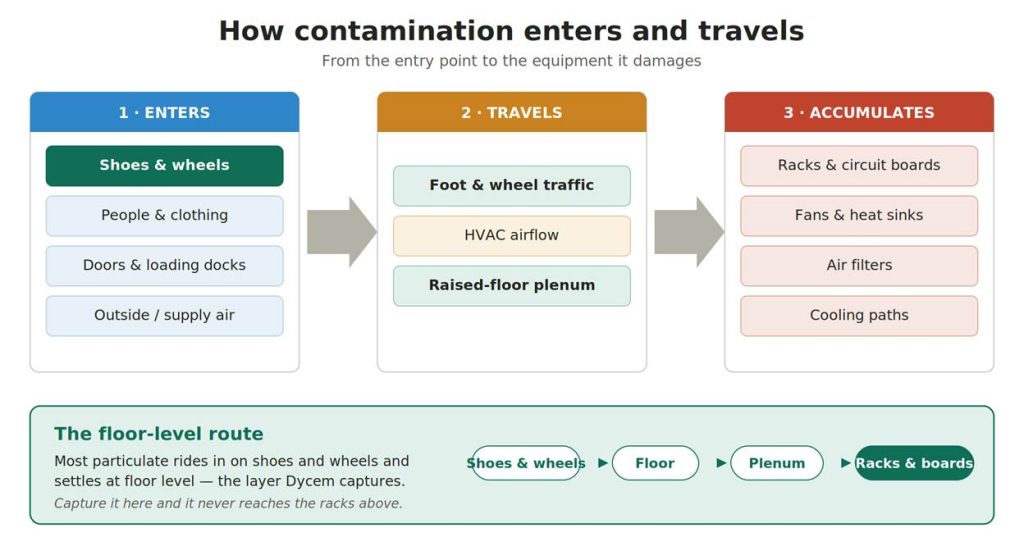
Figure 1. How contamination enters a facility, moves through it, and accumulates in equipment — and the floor-level route Dycem intercepts.
Most contamination is not generated inside the white space…it is carried in. People bring it on clothing and footwear; carts and equipment roll it in; outside air delivers it through intakes; and construction or maintenance releases it directly into controlled zones. Once inside, it travels. Foot and wheel traffic move it across the floor, HVAC airflow circulates it, and in a raised-floor facility the pressurized plenum lifts settled particulate up through perforated tiles and into the racks above.
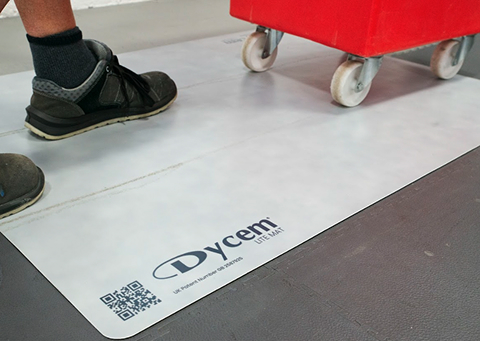
The most important point for control: a large share of particulate enters at floor level, on shoes and wheels, and settles on the floor before it is redistributed. Capture it at the entrances and transitions and it doesn’t reaches the equipment it would otherwise damage.
The three types of contamination
Contamination in a data center falls into three broad categories, though they are far from equal in how often they cause problems.
Physical (particulate)
Dust, fibers, metallic particles, zinc whiskers, and statically charged debris. This is the most common and most disruptive category: it blocks airflow, fouls filters and heat sinks, and can short-circuit boards directly.
Chemical (gaseous)
Corrosive gases react with the metals on circuit boards and cause creep corrosion, a progressive failure that can kill hardware even in a visibly clean room. It has its own severity scale and is a serious, often-overlooked risk for facilities near industrial or high-pollution areas.
Microbiological
Mold spores, pollen, and other organic matter. In most data centers, this is a minor concern relative to particulate and gaseous contamination. It becomes more relevant in humid climates or facilities using economizers and free-air cooling, where outside air and moisture are introduced more directly.
What contamination damages
Contamination works against the three things a data center is designed to protect: uptime, cooling efficiency, and hardware life. Contamination can cause:
- Reduced reliability and life of the equipment as dust builds up on and inside equipment
- Service interruptions and downtime, often from intermittent, hard-to-diagnose faults
- Airflow restriction and cooling inefficiency as filters, fans, and heat sinks clog, forcing thermal throttling
- Direct hardware damage, from conductive shorts to gaseous creep corrosion
- Elevated fire risk where particulate accumulates in dense, high-power environments
- Increased scrutiny during audits and technical reviews
The costliest failures are often the subtle ones: a fan working harder, a board running hotter, an intermittent error no one can reproduce. With each failure quietly shortening the life of expensive infrastructure.
Where contamination comes from
Three recurring sources account for most of the contamination load:
- Personnel — Technicians continuously shed skin and hair particles and track in outside dust on clothing and footwear.
- Facility — Raised floors trap dust beneath the tiles, and construction or fit-out activity releases particulate and debris into controlled spaces.
- Atmosphere — Airborne contaminants such as pollen, spores, and fine pollution particles enter through ventilation and during maintenance.
Across all three, the common thread is movement at floor level. Most of what enters does so low — on shoes, wheels, and settling dust — which is exactly why the floor is the most effective place to intercept it.
Cleanliness standards and targets
Data center contamination is governed by a small set of recognized standards. Each links to a dedicated guide.
- ISO 14644-1 — Defines airborne cleanliness levels. Many data centers reference ISO Class 8 to support reliable operation of sensitive equipment.
- ISO 14644-2 — Focuses on maintaining that cleanliness during daily operations through monitoring and control of ongoing sources.
- ASHRAE TC 9.9 — Provides data center–specific guidance on environmental risks, including particulate that affects airflow, cooling, and reliability.
- ISA-71.04 — Classifies gaseous corrosion severity; G1 is the target for most facilities.
Dycem supports the particulate side of these standards by controlling contamination at the floor, where much of it enters, helping reduce transfer into critical and controlled zones.
Why this matters more now: AI and high density
As demand for data centers accelerates with the expansion of AI, environmental requirements are tightening. High-performance hardware such as NVIDIA GPUs now calls for ISO Class 8 conditions to ensure reliability and peak performance. Denser racks also move more air and generate more heat, which pulls a greater volume of particulate through the facility and concentrates it precisely where it does the most damage. The result is a growing need for contamination control at every level. Most importantly, the floor.
Contamination control across the facility lifecycle
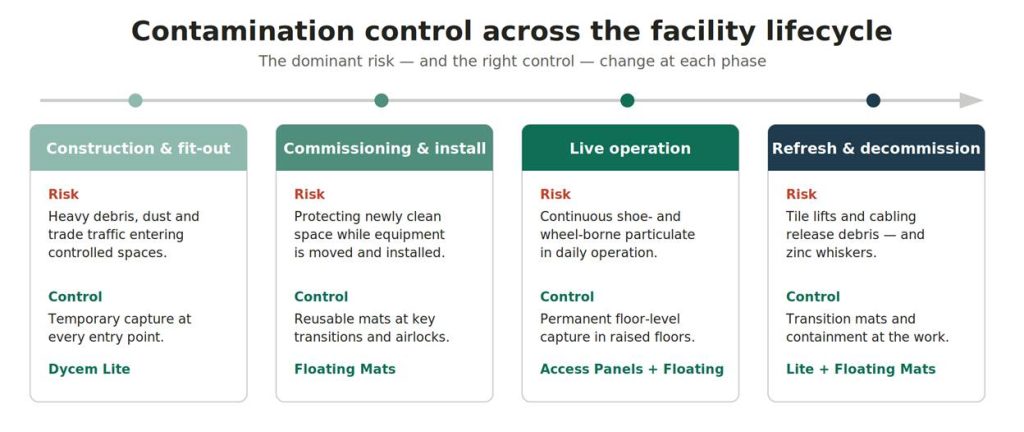
Figure 2. The dominant contamination risk and the recommended control at each phase of the facility lifecycle.
The risks change as a facility moves from build to operation, but so does the right floor-level contamination control. During construction and fit-out, the priority is keeping debris out of controlled space with temporary particulate capture at every entry. Through commissioning and equipment installation, reusable mats protect newly clean areas. In live operation, permanent floor-level capture handles the continuous particulate load from daily traffic and use. Lastly as the building grows into a refresh or needs to be decommissioned, there are contamination controls ready to be used. It’s during these phases where there is the greatest chance of contamination control becomes critical again, because these are events that release settled debris and zinc whiskers.
A layered approach: where floor-level control fits
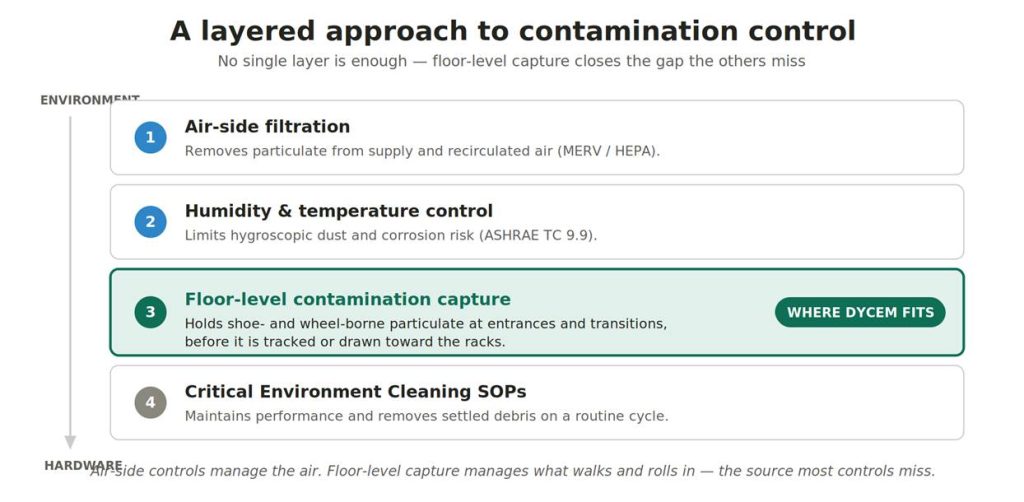
Figure 3. Contamination control is a layered defense. Most layers manage the air; floor-level capture manages what walks and rolls in.
Effective contamination control in a data center takes a layered approach. Air filtration, humidity and temperature control, and gaseous scrubbing each manage part of the problem, but they all manage the air. None of these controls truly address the contamination that walks and rolls in at floor level, where a large share of particulate originates. Floor-level capture closes that gap, holding shoe- and wheel-borne particulate at entrances and transitions before it can be tracked further or drawn into the white space or critical points. Combined with routine critical environment cleaning SOPs, it completes a defense that protects equipment from every direction.
Assess your data center’s contamination risk
A quick way to gauge your exposure is to inspect the area with the following items. The more that apply, the stronger the case for floor-level control:
- Raised-floor construction, especially with older or zinc-plated tiles
- High personnel and equipment traffic, or frequent maintenance
- Active construction or fit-out in or near live halls
- High-density or GPU deployments targeting ISO Class 8
- Reliance on disposable sticky mats, or no floor-level control at all
Request a Site Survey where our team will identify your highest-risk areas and recommend placement and types of contamination control flooring.